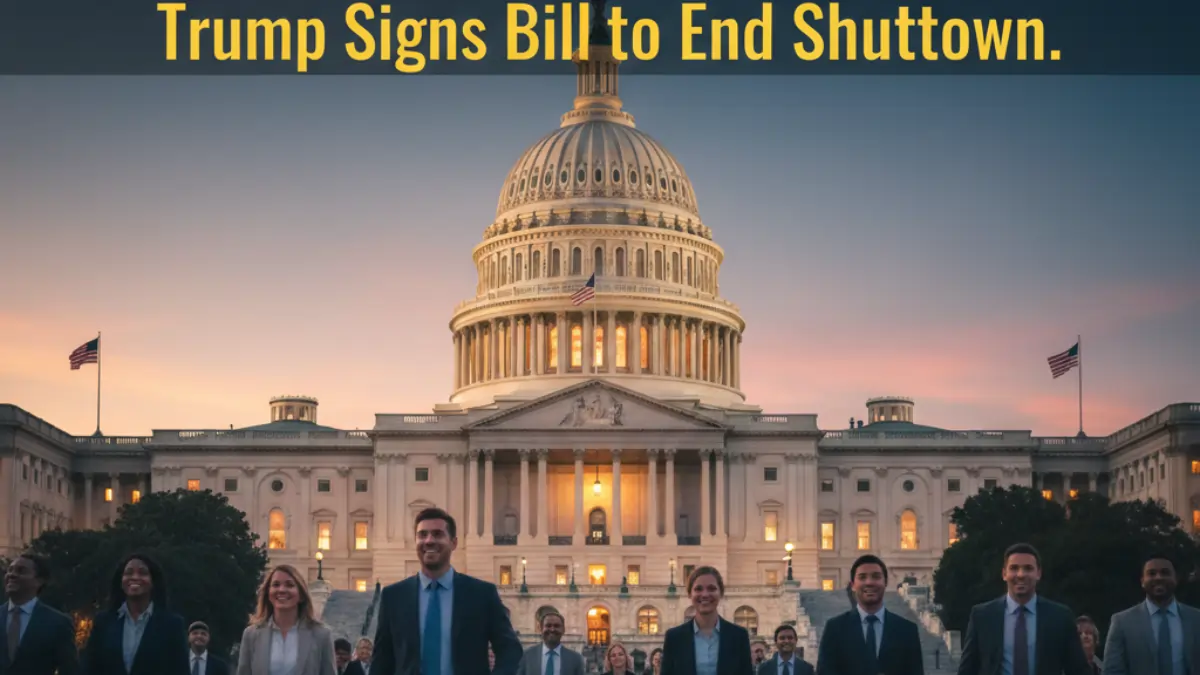
The United States breathed a sigh of relief this week as President Donald Trump officially signed a massive funding package, ending the partial government shutdown that had briefly paralyzed several federal agencies. The move, which followed a high-stakes vote in the House, marks a return to administrative stability and ensures that essential services—from national parks to federal offices—are once again fully operational for the American people.
A Swift Resolution for Federal Workers
The shutdown, while shorter than previous historical closures, created a wave of uncertainty for thousands of federal employees. On Tuesday, however, the House passed the Consolidated Appropriations Act, 2026, with a narrow but decisive 217-214 vote. Following the President’s signature, the Office of Management and Budget (OMB) issued a direct memo for all agencies to reopen in a “prompt and orderly manner.” As of February 4, 2026, federal employees have officially resumed their duties, both remotely and at their duty stations.
What’s Inside the 2026 Funding Bill?
The newly signed legislation is not just a temporary fix; it includes five full-year spending bills that provide long-term clarity for various departments. Key highlights of the package include:
- Infrastructure Investment: Continued support for national transit and energy projects.
- Service Restoration: Full staffing for the IRS, Social Security Administration, and National Parks.
- Short-term DHS Extension: A two-week funding bridge for the Department of Homeland Security (DHS) to allow for deeper negotiations on immigration and border enforcement.
The Road Ahead: Immigration and DHS
While the broader government is back in business, the spotlight now shifts to February 14, when the temporary funding for the DHS is set to expire. Democrats and Republicans are currently locked in intense negotiations regarding immigration enforcement and ICE operations. President Trump has signaled a firm stance on border security, while congressional leaders are working to find a bipartisan middle ground to avoid another lapse in mid-February.
Impact on the American Public
For the average American, the end of the shutdown means that passport processing, small business loan approvals, and federal housing assistance will return to normal speed. The swift resolution has also bolstered market confidence, with economists noting that a prolonged shutdown was the last thing the 2026 economy needed.
Conclusion
The signing of the US government funding bill 2026 is a significant win for governance and national stability. By prioritizing the reopening of federal functions, the administration has cleared the path for the country to focus on its larger goals for the year. As federal offices light up once again across Washington D.C., the message is clear: America is back to work.