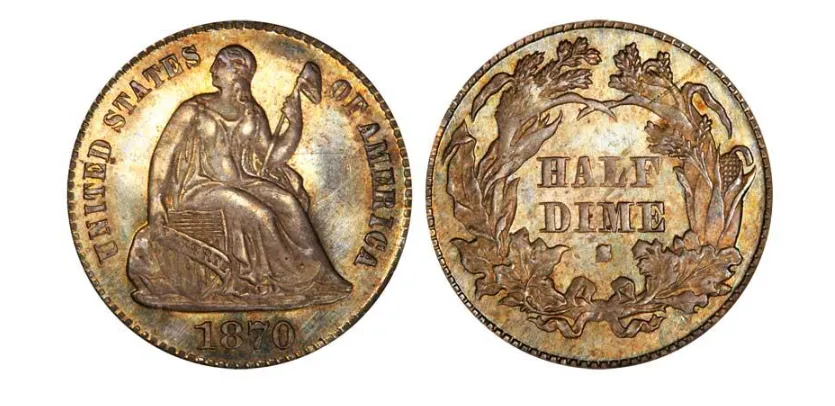
This is not just a rare coin. It is a coin that, for more than a century, wasn’t even supposed to exist. No official mintage records listed it. No collector had seen it. No catalog mentioned it. For 108 years, it lived in total obscurity—until one quiet day in 1978 changed everything.
Today, that same tiny silver coin—measuring just under 16 millimeters—has become one of the most valuable and mysterious artifacts ever produced by the United States Mint.
When it sold in 2023 for $3.12 million, it didn’t just set a price milestone. It confirmed something collectors had long suspected:
Sometimes the greatest treasures are the ones no one is looking for.
Chapter 1: Understanding the Half Dime
Before diving into the mystery, it’s important to understand what a “half dime” actually is.
The half dime was a five-cent silver coin used in the United States before the introduction of the modern nickel. Minted from the late 18th century until 1873, it played a crucial role in everyday commerce.
Unlike today’s five-cent coin, which is made of base metal, the half dime was composed of:
- 90% silver
- 10% copper
It was small, lightweight, and widely circulated—making it easy to lose, spend, and overlook.
By the late 1860s, however, the U.S. government was transitioning away from silver five-cent coins in favor of the more durable nickel version. This transition would eventually lead to the discontinuation of the half dime in 1873.
That timing makes the 1870-S half dime even more fascinating. It appeared at the very end of the denomination’s life—when production was already declining.
Chapter 2: San Francisco and the Birth of a Mystery
The story begins in the rapidly growing city of San Francisco during the late 1860s.
The California Gold Rush had transformed the region into a major economic hub. To handle the massive flow of precious metals, the government established a branch mint in the city in 1854.
By 1870, the original mint building had become inadequate. Plans were already underway to construct a larger, more advanced facility—what would later become known as the famous “Old Mint.”
As part of the construction process, officials organized a cornerstone ceremony in May 1870. This was not unusual. It was common practice to place coins and other artifacts inside a building’s cornerstone as a kind of time capsule.
According to later-discovered archival records, mint officials authorized the production of one example of each denomination for inclusion in the cornerstone.
Here’s where things get interesting.
At that time, several denominations had no regular San Francisco production in 1870, including:
- Half dime
- Quarter
- Silver dollar
- Three-dollar gold coin
To complete the ceremonial set, the mint needed to strike special examples of these coins.
This explains why an 1870-S half dime might have been created.
But it does not explain why one exists outside the cornerstone.

Chapter 3: The Coin That Disappeared From History
For decades, collectors and historians believed no such coin existed.
There were no official mint reports listing an 1870-S half dime. Standard references were silent. Even the most dedicated numismatists had no reason to suspect it had ever been struck.
This silence lasted for more than a century.
Imagine that: a coin created under official authority, yet completely absent from the historical record.
It wasn’t just rare.
It was invisible.
Chapter 4: The 1978 Discovery
Everything changed in early 1978.
In a quiet suburban coin shop in Illinois, a man walked in carrying a small box of coins. There was nothing extraordinary about the collection at first glance.
But among those coins was something that would shock the numismatic world.
An 1870 half dime… with an “S” mintmark.
At first, the dealers assumed it must be a mistake—perhaps a misidentified coin or an altered piece.
After all, no such coin was supposed to exist.
But as they examined it more closely, doubts turned into curiosity—and then into excitement.
If the coin was genuine, it would represent one of the most important discoveries in American coin collecting history.
Chapter 5: Authentication and Scientific Testing
Because of its potential significance, the coin underwent rigorous testing.
Experts didn’t rely on simple visual inspection. Instead, they applied advanced scientific methods, including:
- Microscopic analysis
- Scanning electron microscopy
- Precision weight measurements
- Metal composition testing
The goal was simple: determine whether the coin had been altered or forged.
The results were decisive.
There was no evidence of tampering.
No added mintmark.
No altered date.
No soldering or manipulation.
The coin was authentic.
What had once been considered impossible was now proven real.
Chapter 6: A Mystery With No Clear Answer
Even after authentication, one question remained:
How did the coin leave the mint?
If the original example was sealed inside the cornerstone, the known specimen must represent an additional strike.
But why would the mint produce more than one?
Several theories have been proposed:
Theory 1: Mint Employee Kept It
Some researchers believe a mint official—possibly Coiner J.B. Harmstead—may have retained an extra piece as a souvenir or presentation item.
Theory 2: Special Presentation Coin
The coin may have been struck as a presentation piece for a dignitary or official.
Theory 3: Assay Commission Sample
Another possibility is that it was created for testing purposes, though records do not fully support this theory.
Despite decades of research, no explanation has been definitively proven.
The mystery remains unsolved.
Chapter 7: Physical Characteristics
The known 1870-S half dime is a remarkable specimen.
Its key features include:
- Composition: 90% silver, 10% copper
- Weight: Approximately 1.24 grams
- Diameter: 15.9 mm
- Edge: Reeded
The coin also displays:
- Prooflike reflective surfaces
- A partial wire rim
- Sharp details with minor strike weakness in certain areas
It has been graded MS64 and approved by CAC, indicating high quality and strong eye appeal.
Chapter 8: Record-Breaking Value
The coin’s journey through the market has been just as fascinating as its origin.
Over the decades, its value has steadily increased:
- 1980: $425,000
- 1985: $176,000
- 1986: $253,000
- 2004: $661,250
- 2009: $1.4 million (private sale)
- 2023: $3,120,000
The 2023 sale through Heritage Auctions confirmed its status as one of the most valuable silver coins ever sold.
Chapter 9: Why Collectors Care
Collectors are drawn to the 1870-S half dime for three main reasons:
1. Absolute Rarity
Only one verified collectible example exists.
2. Historical Significance
It is directly tied to a major moment in American mint history.
3. Enduring Mystery
No one knows exactly how it left the mint.
This combination is incredibly rare—and incredibly desirable.
Chapter 10: A Coin That Changed Numismatics
The discovery of the 1870-S half dime forced experts to reconsider long-held assumptions about mint records and historical accuracy.
It proved that:
- Official records can be incomplete
- Important artifacts can remain hidden for generations
- New discoveries are always possible
In short, it reminded collectors that history is never fully written.
FAQs
What is the 1870-S Liberty Seated Half Dime?
It is an ultra-rare U.S. silver coin struck in 1870 at the San Francisco Mint, with only one known collectible example.
Why is it so valuable?
Its value comes from extreme rarity, historical importance, and the mystery surrounding its existence.
How many exist?
Only one verified collectible specimen is known today.
Where was it found?
It surfaced in a suburban Illinois coin shop in 1978.
What is its highest recorded price?
It sold for $3.12 million in January 2023.
Is it possible more exist?
While unlikely, the mystery leaves open the possibility—however small.
Conclusion: The Power of the Unknown
The 1870-S Liberty Seated Half Dime is more than a coin.
It is a story of disappearance, rediscovery, and unanswered questions.
It reminds us that even in a world filled with data and documentation, there are still secrets waiting to be uncovered.
And sometimes, those secrets come in the smallest possible form—a 15.9 millimeter piece of silver that changed history forever.