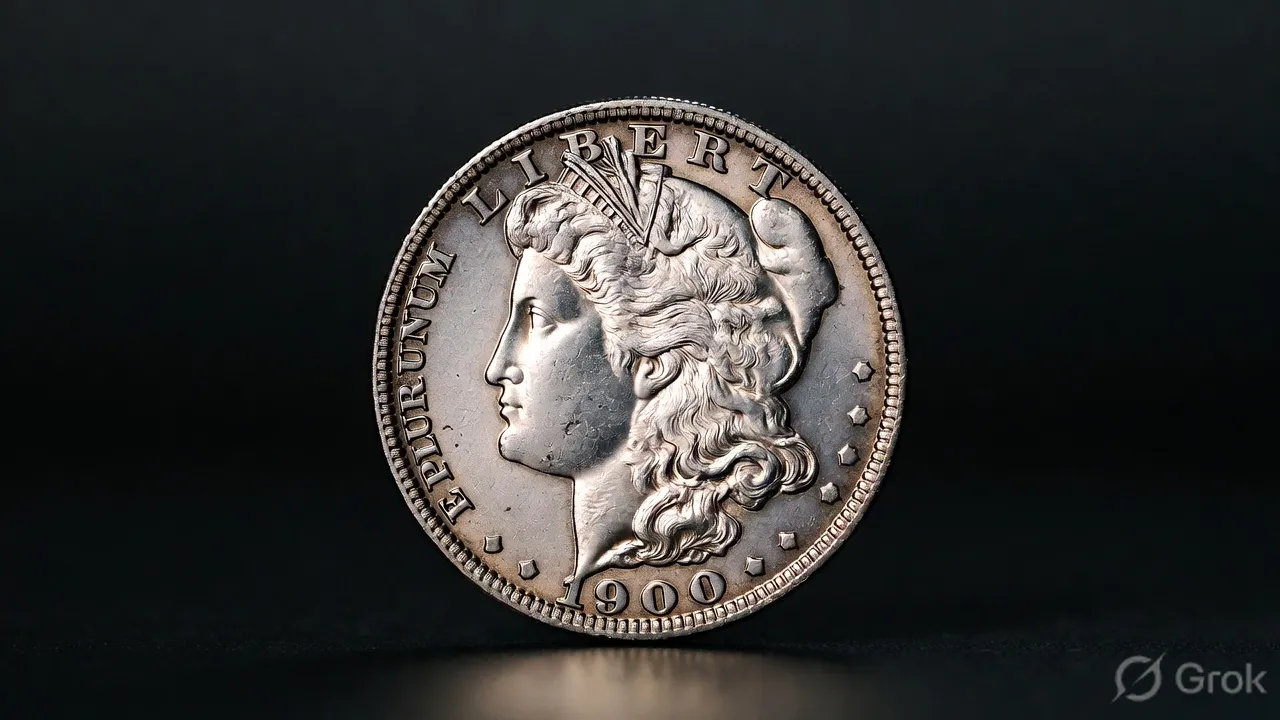
Let’s be honest if you’ve been searching online about the 1900 Morgan Dollar, you’ve probably stumbled across some wild headlines. “Rare coin worth $470 million!” Sound familiar? Before you start planning your early retirement, let’s slow down and talk about what this coin is really worth.
A Little History First
The Morgan Silver Dollar has a story worth telling. Designed by George T. Morgan and first minted in the late 1800s, it was born during a turbulent chapter in American economic history — when silver miners, farmers, and politicians were all fighting over what money should even mean in this country.
The coin itself? Genuinely beautiful. Lady Liberty graces the front with a classical dignity, while a bold heraldic eagle spreads its wings on the back. And unlike a lot of modern coins, there’s real substance here — literally. Each Morgan Dollar is 90% silver, weighing in at 26.73 grams with a diameter of 38.1 mm. It carries roughly 0.7734 troy ounces of pure silver.
By 1900, these coins were rolling out of three U.S. Mint facilities — Philadelphia, New Orleans, and San Francisco. Each location left its own fingerprint on the coins it made, and that matters a lot to collectors today.
Okay, Is It Worth $470 Million or Not?
No. It isn’t.
There’s no verified auction record anywhere near that number. Not even close. The most valuable coins ever sold at public auction — think legendary rarities with documented history — typically land somewhere between a few million and maybe $20 or $30 million on a remarkable day. Even those sales are rare events that make headlines across the numismatic world.
The $470 million figure? It’s the kind of number that gets clicks, not bids. If someone is using that claim to sell you something, walk away.
What Actually Drives Value
Here’s where things get genuinely interesting — because some 1900 Morgan Dollars are worth serious money. Just not hundreds of millions.
Where it was minted. The small letter stamped on the reverse tells you a lot. San Francisco coins tend to have sharper, crisper details. New Orleans coins are softer in strike but carry some of the most exciting varieties. Philadelphia coins were made by the millions and are generally more common — but exceptional examples still turn heads.
Its condition. This is probably the single biggest factor. A coin that spent decades rattling around in pockets looks very different from one that sat untouched in a mint bag for a century. Professional grading services assign a numerical score from 1 to 70, and the difference between a coin grading MS64 and MS67 can be thousands of dollars.
Whether it’s a proof. Proof coins were never meant for everyday use. Made with special dies and extra care, they have a mirror-like finish that’s unmistakable. The 1900 proof mintage was tiny, which is exactly why collectors chase them so aggressively.
The die variety. This is where coin collecting gets almost detective-like. Certain dies used in 1900 created subtle but distinctive differences — tiny anomalies that most people would walk right past. But to the right collector, they’re everything.
The 1900-O/CC: A Coin With a Hidden Secret
Of all the 1900 Morgan varieties, none captures the imagination quite like the 1900-O/CC.
Here’s what happened: when the Carson City Mint closed in 1893, some of its dies were shipped to New Orleans and repurposed. Look carefully at one of these coins under magnification, and you’ll see it — the ghost of a “CC” peeking out beneath the “O” mint mark. Two mints, one coin.
In circulated condition, this variety typically sells for $500 to $1,500. But in Mint State grades, it can climb to $20,000 or higher. It’s one of those coins that rewards patient collectors who know what they’re looking for.
Real 2026 Price Ranges
Here’s a straightforward look at what the market actually looks like right now:
- 1900 Philadelphia (no mint mark), circulated: $40–$75
- 1900-O (New Orleans), circulated: $45–$90
- 1900-S (San Francisco), circulated: $100–$250
- 1900-O/CC variety: $500 to $20,000+ depending on grade
- 1900 Proof coins: $5,000 to $50,000 or more
- Any issue in MS67 or above: $10,000 to $100,000+, sometimes more at auction
These aren’t guesses — they’re based on documented sales through established auction houses and dealer markets.
Silver Value vs. Collector Value
Every 1900 Morgan Dollar has a floor — the value of its silver content. At current silver prices, that base value sits at a meaningful but modest level. It’s a nice safety net.
But the coins that excite serious collectors aren’t about silver weight. They’re about what makes a specific coin different from the million others that look just like it. A low population in high grades. A known variety. A remarkable surface that’s survived 125 years looking almost as fresh as the day it was struck.
That’s the gap between a $50 coin and a $50,000 coin. Same date, same design — completely different story.
How to Collect Smart in 2026
A few thoughts from the more experienced corner of the hobby:
Always buy certified. High-value coins should live in slabs from PCGS or NGC. Counterfeits exist, and an uncertified coin asking a premium price should raise immediate questions.
Chase condition. It sounds obvious, but collectors who focus on quality over quantity tend to fare much better over time. A single gem-grade example usually outperforms five mediocre ones.
Read the population reports. Both major grading services publish data on how many coins they’ve certified in each grade. When you see a coin graded MS66 and there are only 12 examples in that grade with none higher — that’s meaningful scarcity.
Eye appeal matters more than people admit. Two coins can share the same technical grade and look completely different. Original surfaces, attractive toning, and a strong strike can push a coin’s real-world value well above its official grade.
Ignore the hype. Seriously. The Morgan Dollar hobby is full of wonderful people and genuinely fascinating coins. It doesn’t need fictional price claims to make it exciting.
Why This Coin Still Matters
The 1900 Morgan Dollar isn’t just a piece of old silver. It’s a window into a time when American industry was accelerating, when the debate over money was genuinely fierce, and when craftsmen at the U.S. Mint were producing art objects that would outlast all of them by more than a century.
That’s not nothing. And it’s why, in 2026, collectors from around the world still compete for the finest examples they can find.
The $470 million coin doesn’t exist. But the real story — of rare varieties, exceptional survivors, and a design that has never stopped turning heads — is more than interesting enough on its own.
Bottom line: Most 1900 Morgan Dollars are accessible, affordable, and a pleasure to own. A small number are genuinely rare and valuable. None of them are worth hundreds of millions. And if you know what to look for, this is still one of the most rewarding areas of American numismatics to explore.