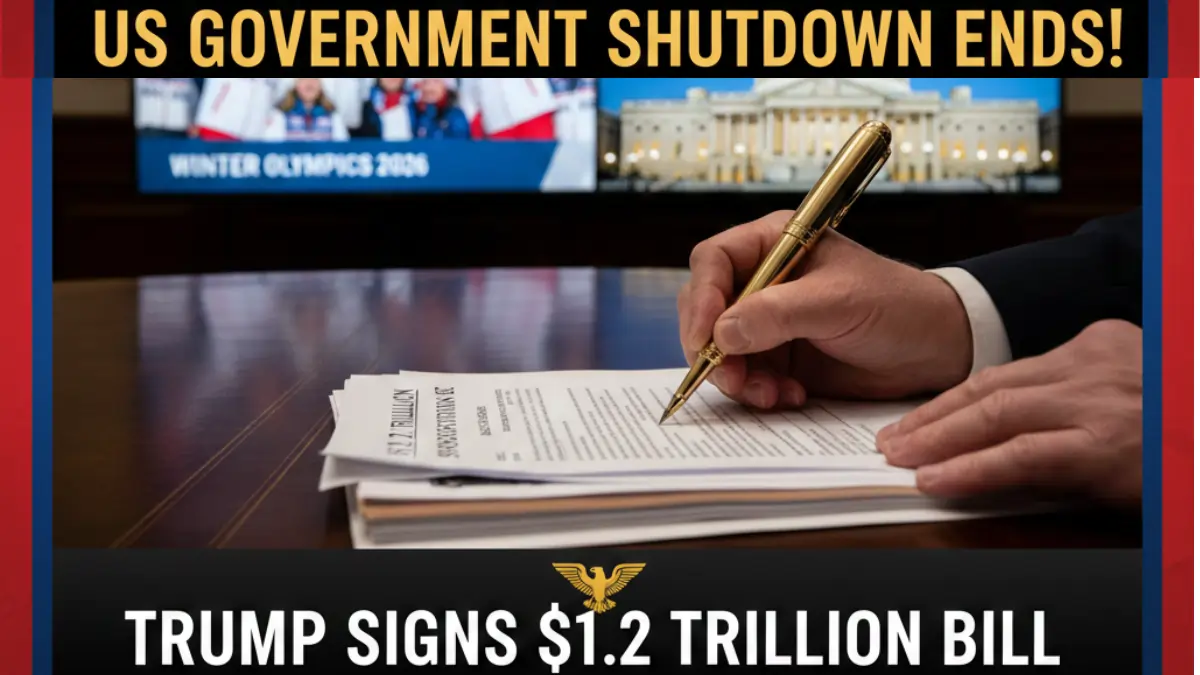
WASHINGTON, D.C. – In a move that brings immediate relief to millions of Americans and stabilizes global financial markets, the 2026 federal standoff has reached a conclusion. Late Tuesday night, President Donald Trump signed the $1.2 trillion appropriations package, officially ensuring that the US Government Shutdown ends in 2026 after a tense four-day lapse in funding.
The resolution comes at a critical juncture for the administration, as the nation prepares for high-stakes diplomatic summits and the kickoff of the Winter Olympics. The reopening of the federal government signals a temporary truce in a polarized Washington, though the underlying fiscal debates remain far from over.
The Midnight Breakthrough: How the Deal Was Struck
The path to reopening the government was fraught with legislative hurdles. For the past 96 hours, federal agencies had been operating on essential-personnel-only status, leaving national parks closed, passport processing stalled, and thousands of federal contractors in a state of limbo.
The primary point of contention centered on the “Border Security and Interior Enforcement” clause of the 2026 budget. Republican leadership pushed for an aggressive expansion of deportation logistics, while a coalition of Democrats and moderate Republicans sought a more balanced approach to international aid and social safety nets.
The breakthrough occurred when a compromise was reached regarding the Department of Homeland Security (DHS). The signed bill provides a “bridge funding” mechanism that keeps DHS operational through mid-February, allowing for a broader, separate debate on immigration policy without holding the rest of the federal government hostage.
Immediate Relief for Federal Employees and Contractors
The most tangible impact of the news that the US Government Shutdown ends in 2026 is the return to work for approximately 800,000 federal employees. These workers, ranging from TSA agents to administrative staff at the IRS, had been facing the prospect of missed paychecks and mounting personal debt.
The signed legislation includes a “Hold Harmless” provision, guaranteeing full back pay for all furloughed workers. This move is seen as essential for maintaining morale within the federal workforce, which has faced significant stress due to repeated fiscal cliffs over the last decade. Federal contractors, who often do not receive back pay in these scenarios, are also breathing a sigh of relief as project funding for infrastructure and defense has been re-authorized.
Economic Implications: Stabilizing a Volatile Market
Wall Street analysts had warned that a prolonged shutdown could shave up to 0.2% off the quarterly GDP. However, the swift resolution has largely mitigated those fears. Upon the news of the signing, S&P 500 futures showed a marked increase, reflecting investor confidence in the nation’s fiscal continuity.
The 2026 economic landscape is particularly sensitive. With the Federal Reserve still battling lingering inflationary pressures, a government shutdown would have delayed critical economic data releases, such as the Consumer Price Index (CPI) and employment reports. These reports are the “GPS” for the economy; without them, the Fed would have been “flying blind,” potentially leading to miscalculated interest rate adjustments.
Impact on National Security and Global Diplomacy
Beyond the domestic economy, the end of the shutdown has profound implications for US foreign policy. The United States is currently mediating high-level peace talks in Abu Dhabi regarding the Russia-Ukraine conflict. A shuttered government would have signaled domestic weakness to international adversaries and allies alike.
With the funding bill signed, the State Department can now fully fund the diplomatic missions essential for these negotiations. Furthermore, the Department of Defense has secured the necessary allocations for its 2026 modernization programs, ensuring that military readiness is not compromised during this period of global transition.
The Winter Olympics and Public Services
For the average American citizen, the most visible change will be the restoration of public services. National parks, which saw gates locked and visitor centers closed over the weekend, are expected to be fully operational by Thursday morning.
The timing is also significant for sports fans. As the 2026 Winter Olympics begin, the federal agencies responsible for coordinating security and travel logistics for Team USA are back at full capacity. This ensures that the American delegation has the full weight of the government’s support as they compete on the international stage.
A Temporary Truce: Looking Toward the Future
While the headline “US Government Shutdown Ends 2026” provides a sense of closure, political analysts warn that this is a “patchwork” solution. The $1.2 trillion bill covers the majority of government functions, but several “poison pill” amendments regarding environmental regulations and tech industry oversight were merely delayed, not resolved.
The next fiscal hurdle is scheduled for mid-February, when the DHS bridge funding expires. If Congress cannot reach a permanent agreement on border enforcement and immigration by that deadline, the nation could find itself back in a similar standoff.
For now, however, the lights are back on in Washington. Federal agencies are processing the backlog of applications, the stock market is reacting with cautious optimism, and the American public can return to a sense of normalcy.
Conclusion: A Win for Governance?
The resolution of the 2026 shutdown serves as a reminder of the complexities of modern American governance. While the brinkmanship displayed over the last week caused unnecessary anxiety for federal workers and their families, the final signing of the bill proves that the system’s “relief valves” still function—albeit at the final hour.
As the government reopens, the focus shifts to how the administration will utilize this newly secured $1.2 trillion. From infrastructure projects to national defense and social programs, the 2026 budget will define the trajectory of the country for the remainder of the year.