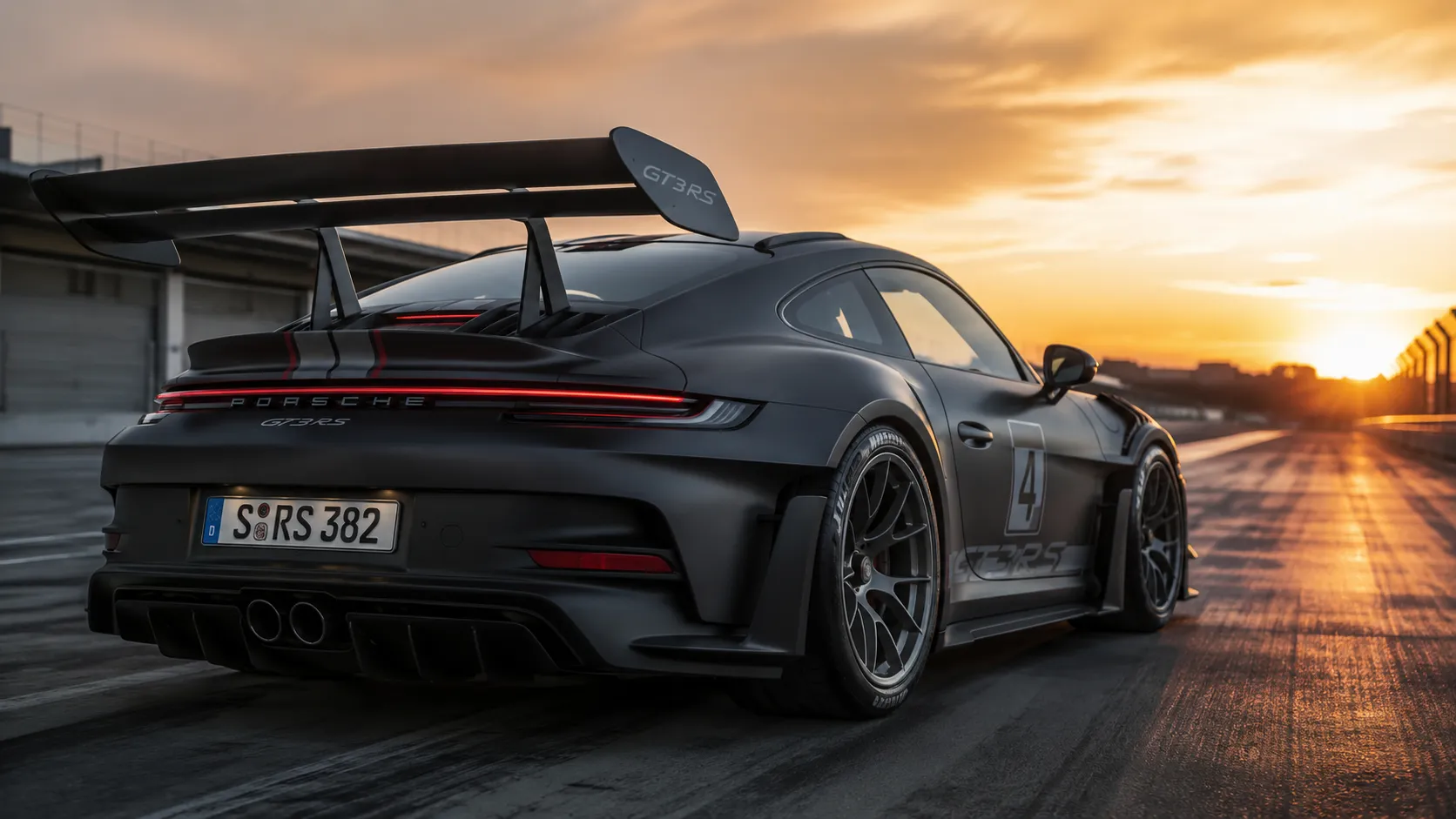
Every few months, the internet rediscovers the Porsche 911 GT3 RS. A new spy shot leaks, a lap time gets posted, a dealer markup goes viral, and the same specs get recycled across hundreds of outlets: 518 horsepower, a screaming naturally aspirated flat-six, a 0-60 sprint in the low three-second range. Search “2025 Porsche 911 GT3 RS” today and you’ll find that story told 500-plus different ways.
Here’s what most of that coverage is missing: the 2025 model isn’t just another halo car update. It’s quietly becoming the final chapter of a naturally aspirated era at Porsche — and that shift is starting to reshape how buyers, collectors, and dealers are thinking about the car right now, in real time.
What’s Actually New Right Now
The 2025 GT3 RS itself didn’t change much on paper. Porsche confirmed the car would carry over largely unchanged for the 2025 model year even as the rest of the 992-generation 911 lineup — including the hybridized Carrera GTS — received updates. That “no change” decision was deliberate, and it’s exactly why the car is generating fresh attention: Porsche was saving the big news for what comes next.
Spy shots of a facelifted GT3 RS prototype have been circulating for the better part of a year, testing at the Nürburgring with a reworked rear diffuser, a larger top-mounted wing, new front-end louvres, and — the detail that’s actually rattling the enthusiast world — a rumored switch to a turbocharged flat-six for the next-generation car, expected to be revealed around August 2026. For a model whose entire identity has been built on a screaming, naturally aspirated engine that revs to nearly 9,000 rpm, that’s not a minor spec tweak. It’s a philosophical pivot.
That single detail is the piece most wire coverage buries or skips entirely in favor of repeating the same horsepower figure. But it’s the reason the current 2025 GT3 RS is suddenly worth a second look.
The Numbers That Still Matter
Strip away the hype and the current-generation GT3 RS is still one of the most extreme road-legal Porsches ever built for public sale. It’s powered by a 4.0-liter naturally aspirated flat-six producing 518 horsepower and 342 lb-ft of torque, sending power exclusively through Porsche’s PDK dual-clutch transmission — there’s no manual option on this car, unlike the standard GT3, which still offers three pedals for purists. At roughly 3,268 pounds, it’s light enough that the power-to-weight math translates to a 0-60 mph run in about three seconds and a top speed north of 180 mph.
What makes those numbers different from, say, a Turbo S or a McLaren rival isn’t outright pace — it’s how the car gets there. The GT3 RS is built around downforce first, straight-line speed second. Its aerodynamic package, borrowed conceptually from Porsche’s motorsport program, generates more downforce than the outgoing 991-generation GT3 RS at speed, which is part of why it posts Nürburgring lap times that rival cars costing two to three times as much.
Why Naturally Aspirated Matters More Than It Sounds
To a casual reader, “naturally aspirated versus turbocharged” might sound like a footnote. To the people who actually buy these cars, it’s the whole ballgame.
Turbocharging isn’t new to Porsche’s GT department — the 911 Turbo has used forced induction for decades. But the GT3 and GT3 RS lines have stayed deliberately naturally aspirated, largely because throttle response and the top-end scream of a high-revving flat-six are core to what makes these cars feel special on a track versus a stopwatch printout. Porsche’s own motorsport-derived 911 GT3 R race car, which just received an aerodynamics and suspension overhaul for the 2026 season built on more than 500 real-world race starts, still runs a naturally aspirated engine as its foundation.
If the next-generation road car genuinely does move to a turbocharged setup — as recent spy-shot reporting and industry rumor suggest — the 2025 GT3 RS becomes something collectors already have a name for: the last of the breed. Historically, “last naturally aspirated” or “last manual” versions of iconic performance cars don’t just hold value — they appreciate. The final naturally aspirated V10-powered BMW M5, the last non-turbo Ferrari 458 before the 488 arrived, the outgoing manual Porsche Cayman GT4 — all of them saw dealer premiums and secondary-market prices climb specifically because buyers understood a mechanical era was closing.
The Practical Impact: Allocation, Markups, and Timing
This is where the story gets useful for anyone actually shopping, not just reading. GT3 RS units in the U.S. have historically been allocation-only, meaning dealers decide who gets a car at MSRP based on purchase history and loyalty rather than a simple waitlist. That system has produced well-documented dealer markups of $50,000 to $100,000 or more over the car’s roughly $240,000 base price during high-demand windows.
If the “last naturally aspirated GT3 RS” narrative takes hold the way it has with other outgoing platforms, expect three concrete effects over the next 12 to 18 months:
- Tighter allocation on remaining 2025 build slots, as dealers anticipate stronger demand from buyers specifically chasing the outgoing engine architecture rather than the newest tech.
- Firmer resale values on used 2025 and earlier 992-generation GT3 RS cars, mirroring what happened with late naturally aspirated M cars and Cayman GT4s once their successors switched to turbocharged or electrified powertrains.
- A parallel bump in interest around Porsche’s Manthey-Racing-tuned version of the current GT3 RS, which has been positioned as a track-focused halo variant of the outgoing platform — effectively a send-off model in its own right, alongside bespoke Sonderwunsch commissions Porsche has continued building on the current chassis.
None of that is guaranteed. Porsche could hold prices steady, and the new turbocharged rumor could turn out to be wrong or overstated, as spy-shot speculation sometimes is. But the pattern is familiar enough, and the current allocation math tight enough, that it’s worth flagging now rather than after the facelift debuts and the “last of the NA GT3 RS” headlines are unavoidable.
A Historical Comparison Worth Making
Porsche has walked this road before. When the 991-generation GT3 RS gave way to the 992 in 2022, used prices on clean, low-mile 991 RS models didn’t collapse the way ordinary used cars do — they held remarkably flat, and pristine examples with desirable options actually climbed above their original window sticker within a year or two of the new model’s arrival. The GT3 RS badge has a track record of resisting depreciation specifically at generational transition points, which is a very different pattern than what happens with mainstream Porsche models like the base Carrera or Cayman.
If the next GT3 RS really does add turbocharging, the current 2025 car sits in almost the exact position the 991 RS did three years ago: the last representative of a specific, beloved engineering approach, still in production, still purchasable, but with a visible expiration date.
The Takeaway
The 2025 Porsche 911 GT3 RS doesn’t need a new angle to be a great car — it was already one of the most focused, track-capable machines money can buy before any of this facelift chatter started. But the reason it’s suddenly everywhere in automotive coverage isn’t the car itself. It’s the timing.
For anyone actually in the market: if you’ve been sitting on a GT3 RS allocation or eyeing a clean used 2025 model, the window to buy before “last naturally aspirated GT3 RS” becomes the dominant narrative — and the pricing that tends to follow it — is arguably now, not after Porsche’s facelift reveal makes it official. For everyone else simply watching the story unfold, keep an eye on Porsche’s official announcement, expected as soon as this month, for confirmation of whether the rumored turbocharged engine is real. That single detail will determine whether this is a routine mid-cycle refresh or the actual end of an era.