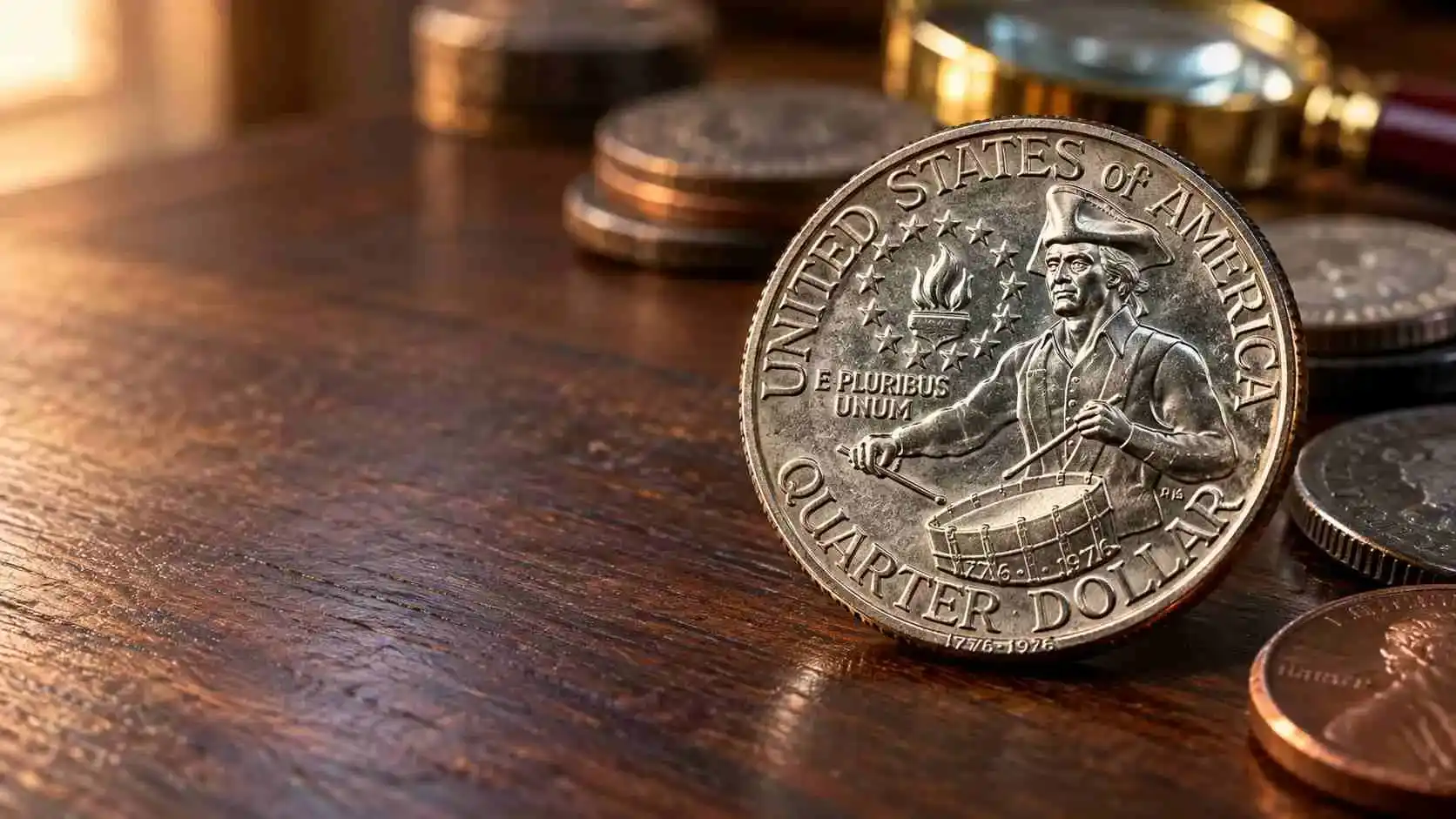
Short answer: Most bicentennial quarters are worth exactly 25 cents. The 40% silver versions marked with an “S” are worth about $5 or more in silver alone, and high-grade, proof, or error coins can sell for anywhere from $10 to several thousand dollars.
If you’ve pulled a quarter with a drummer boy on the back and the dates “1776–1976” out of your change jar, you’re holding one of the most recognizable coins in American history. The big question is whether it’s worth anything. Let’s sort it out.
What Is a Bicentennial Quarter?
To celebrate America’s 200th birthday, the U.S. Mint replaced the usual eagle on the quarter’s back with a colonial drummer boy. The coin also carries the dual date “1776–1976.” It was struck during 1975 and 1976, but every one of them is dated 1776–1976, so you can’t tell a 1975 strike from a 1976 one by looking at the date.
The Mint made them in huge numbers, which is the main reason most are common. Over 1.6 billion went into circulation as copper-nickel clad coins from Philadelphia and Denver. Those billions of pocket-change coins are still worth only face value.
Bicentennial Quarter Value Chart (2026)
| Type | How to Spot It | Typical Value |
|---|---|---|
| Circulated clad (no mint mark or “D”) | Found in pocket change | 25 cents |
| Uncirculated clad | Mint-fresh, often from mint sets | $1–$5 |
| 40% silver, uncirculated (S mint mark) | “S” under the date, sold in collector sets | $5–$20 |
| Silver proof (S mint mark) | Mirror-like finish, usually in a case | $7–$40 |
| High-grade MS-67+ | Professionally graded | $30 to several hundred |
| Top-grade or error coins | Certified by PCGS or NGC | Hundreds to thousands |
These are ballpark figures. Prices move with the silver market and collector demand.
Why Are Some Bicentennial Quarters Worth More?
Three things push the value up: metal, condition, and mistakes.
1. Silver Content
Most bicentennial quarters are copper-nickel clad, but the Mint also made 40% silver versions at the San Francisco facility. They were sold only in collector sets, not released into circulation. That means you won’t find one in your change. You’d find it in an old family coin set.
Each silver quarter holds about 0.0739 troy ounces of silver. To work out the melt value, multiply that by the current silver price. With silver trading above $60 an ounce, the metal alone is worth roughly $4.70 per coin before any collector premium.
2. Condition and Grade
Collectors pay for coins that look nearly perfect. Grading services like PCGS and NGC score coins from 1 to 70. A typical MS-65 silver quarter might bring $10–$20, while the higher grades are much rarer. The scarcest examples, like a 1976-S silver quarter in MS69, can sell for thousands. One MS69 example reportedly sold for $19,200.
3. Mint Errors
Errors can turn a 25-cent coin into a collectible. Look for doubled dies, off-center strikes, or coins struck on the wrong metal blank. Doubled die, overstruck, and struck-through errors can command hundreds of dollars. Real errors are uncommon, and many “errors” people spot are just wear or damage, so get a suspected one checked.
How to Tell If Your Bicentennial Quarter Is Silver
You don’t need special tools for a first check:
- Look for the mint mark. Silver coins carry an “S” below the date or near the portrait. No mark or a “D” means clad.
- Check the edge. A clad quarter shows a copper-colored stripe along the edge. A silver one shows a solid silvery edge with no copper line.
- Weigh it. A clad quarter weighs about 5.67 grams, while the 40% silver version weighs about 5.75 grams. You’ll need a jeweler’s scale to see the difference.
- Listen to it. Silver coins ring when dropped, while clad coins sound duller. It’s a rough test, but it works as a quick filter.
If the “S” is there and the edge has no copper stripe, you likely have a silver coin.
Should You Clean Your Bicentennial Quarter?
No. Cleaning scratches the surface and can cut a collectible coin’s value sharply. Even a gentle rub with a cloth or polish leaves tiny marks that experienced buyers notice immediately. If the coin is dirty, leave it alone, or ask a coin dealer for advice.
Where to Sell a Bicentennial Quarter
Where you sell depends on what you have.
- Common clad quarters: Spend them or keep them as a keepsake. A dealer won’t pay more than face value.
- Silver quarters: A local coin shop or bullion dealer will pay close to melt value, and sometimes a small premium.
- Graded or high-value coins: Auction houses and reputable online marketplaces reach the most buyers. Get the coin graded first if you think it’s top condition.
Whichever route you take, get two or three offers before you sell.
Frequently Asked Questions
Are bicentennial quarters worth anything?
Most are worth only 25 cents. Silver S-mint versions, proofs, high-grade coins, and error coins can be worth much more.
What is the rarest bicentennial quarter?
The top-graded 1976-S silver business strikes are among the rarest. The very best examples have sold for five figures.
How much is a 1776–1976 silver quarter worth?
At least its silver melt value, which is about $4.50 to $5 at today’s prices. Uncirculated and proof examples usually sell for $8–$20, and high grades bring more.
How can I tell if my bicentennial quarter has an error?
Look for doubled lettering, off-center designs, or odd coloring under a magnifying glass. If you spot something unusual, have it authenticated by PCGS or NGC.
Is it worth getting my bicentennial quarter graded?
Only if it looks flawless or shows a clear error. Grading costs money, so it doesn’t pay off for an ordinary coin.
The Bottom Line
Odds are the bicentennial quarter in your pocket is worth 25 cents, but it’s still a neat piece of American history. If you have one with an “S” mint mark, a mirror finish, or a visible error, it’s worth a closer look. Check the edge, note the mint mark, and when in doubt, ask a trusted dealer before selling.