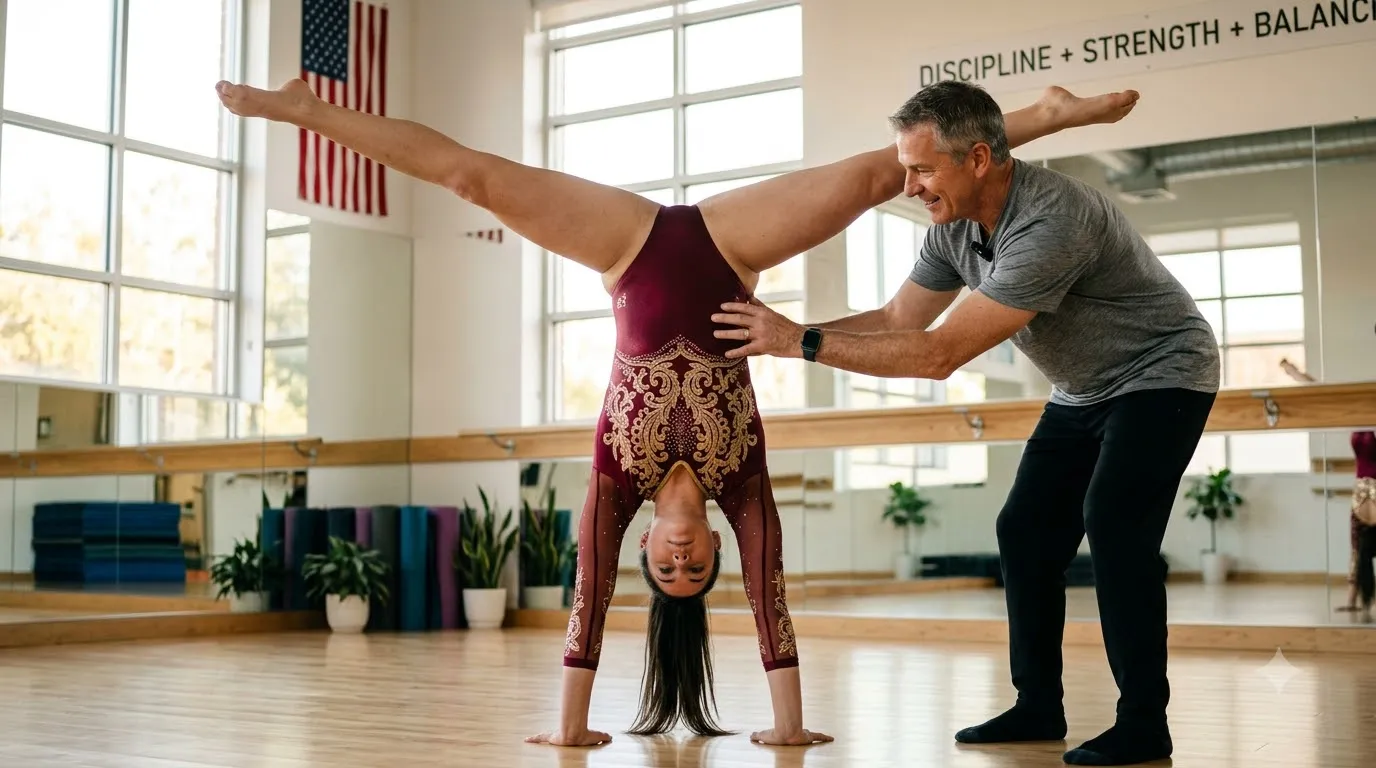
Walk into any serious gymnastics studio and you will notice something before you notice the athletes: the quiet. Sunlight pours through tall windows, shoes squeak softly on the wooden floor, and somewhere a coach is saying just three words: “Slow. Breathe. Hold.”
On the wall, a simple sign sums up the philosophy of the room: Discipline. Strength. Balance. It looks like a motivational poster. In reality, it is a training manual.
The Pose That Looks Effortless
The handstand split is one of the most admired positions in gymnastics and dance. The athlete is fully inverted, hands pressed into the floor, legs extended wide in a straight line. To an outsider it looks graceful, almost weightless.
Underneath that grace is an enormous amount of work. The shoulders are locked and stacked over the wrists. The core is braced to keep the ribs from flaring. The hips stay open, the legs stay active, and the athlete makes hundreds of tiny corrections every second to stay balanced. What looks like stillness is actually constant, controlled movement.
That is the first lesson of the handstand split: what looks easy is usually the result of invisible effort.
The Coach Behind Her
Look closely at any great athlete in training and you will find a coach standing just behind her, hands ready, eyes focused. This is called spotting, and it is one of the most important and least glamorous skills in the sport.
A good spotter does not do the work for the athlete. He gives her enough support to feel safe, and enough freedom to feel the position for herself. When she wobbles, he steadies her. When she finds her line, he lets go a little. Over weeks and months, the support fades until the athlete can hold the pose alone.
The best coaches also read people, not just bodies. They know when to correct a hand position and when to simply smile and say, “That was your best one yet.” Trust is built in those small moments. An athlete will only commit fully to an inverted, high-risk position when she believes the person behind her knows exactly what he is doing.
Discipline: Showing Up Before You Feel Ready
Talent gets headlines. Discipline gets results.
Most athletes who can hold a handstand split have spent years doing unglamorous things: wrist conditioning, shoulder mobility drills, wall-supported holds, and hundreds of failed attempts. They do the same drills on days they feel strong and on days they feel exhausted.
This is the real definition of discipline: repeating the basics when nobody is watching and nothing feels exciting.
If you are trying to build any skill, whether it is fitness, a business, or a new career, the pattern is the same. Progress rarely arrives in a dramatic moment. It builds quietly through small sessions that stack up over time. The athlete who trains twenty focused minutes every day will usually beat the one who trains for three hours once a month.
Strength: Built Slowly and Built Properly
Strength in gymnastics is not about looking powerful. It is about being able to control your own body in space.
A handstand demands strong shoulders, a stable core, resilient wrists, and powerful legs that stay engaged even when fully extended. None of these develop overnight, and none can be rushed safely. Coaches build strength in layers: first support strength, then stability, then control, then the full skill.
This approach protects the athlete as much as it improves her. Rushing into advanced positions without a foundation is how injuries happen. The smartest athletes treat patience as a training tool, not a delay.
A useful rule from the gym applies to everyday life too: build the base before you chase the peak.
Balance: The Skill Beneath Every Other Skill
Balance is often misunderstood. People imagine it as holding perfectly still, but real balance is dynamic. It is the ability to notice when you are drifting and correct quickly, calmly, and without panic.
In a handstand, a tiny shift of the fingertips moves the entire body. Athletes learn to “listen” through their hands and respond almost instantly. They do not fight the wobble; they work with it.
Life works the same way. Careers, finances, health, and family all pull in different directions. Nobody stays perfectly still. The people who do well are not the ones who never wobble. They are the ones who notice early, adjust gently, and keep going.
What You Can Learn From the Studio
You do not need to be a gymnast to use this philosophy. Here are the takeaways anyone can apply:
- Find a good guide. Whether it is a coach, mentor, or experienced friend, someone watching your form can save you years of mistakes.
- Master the basics. Strong fundamentals make advanced skills possible.
- Be consistent, not extreme. Short, regular practice beats occasional bursts.
- Let support fade gradually. Lean on help while you learn, then build the confidence to stand on your own.
- Expect to wobble. Falling out of the position is part of learning it, not proof that you are failing.
If you want to try inverted skills yourself, start with a qualified coach, work near a wall, and progress slowly. Safety is not the opposite of ambition. It is what allows you to keep training for years.
The Moment After the Hold
The most telling part of any training session is not the hold itself. It is the moment right after, when the athlete comes down, shakes out her wrists, and looks back at her coach. He nods. She breathes. They reset and go again.
There is no applause and no big finish, just the quiet satisfaction of a skill getting a little more solid than yesterday.
That is what the sign on the wall is really saying. Discipline gets you into the room. Strength gets you into the position. Balance keeps you there. And the right people standing behind you make the whole journey possible.