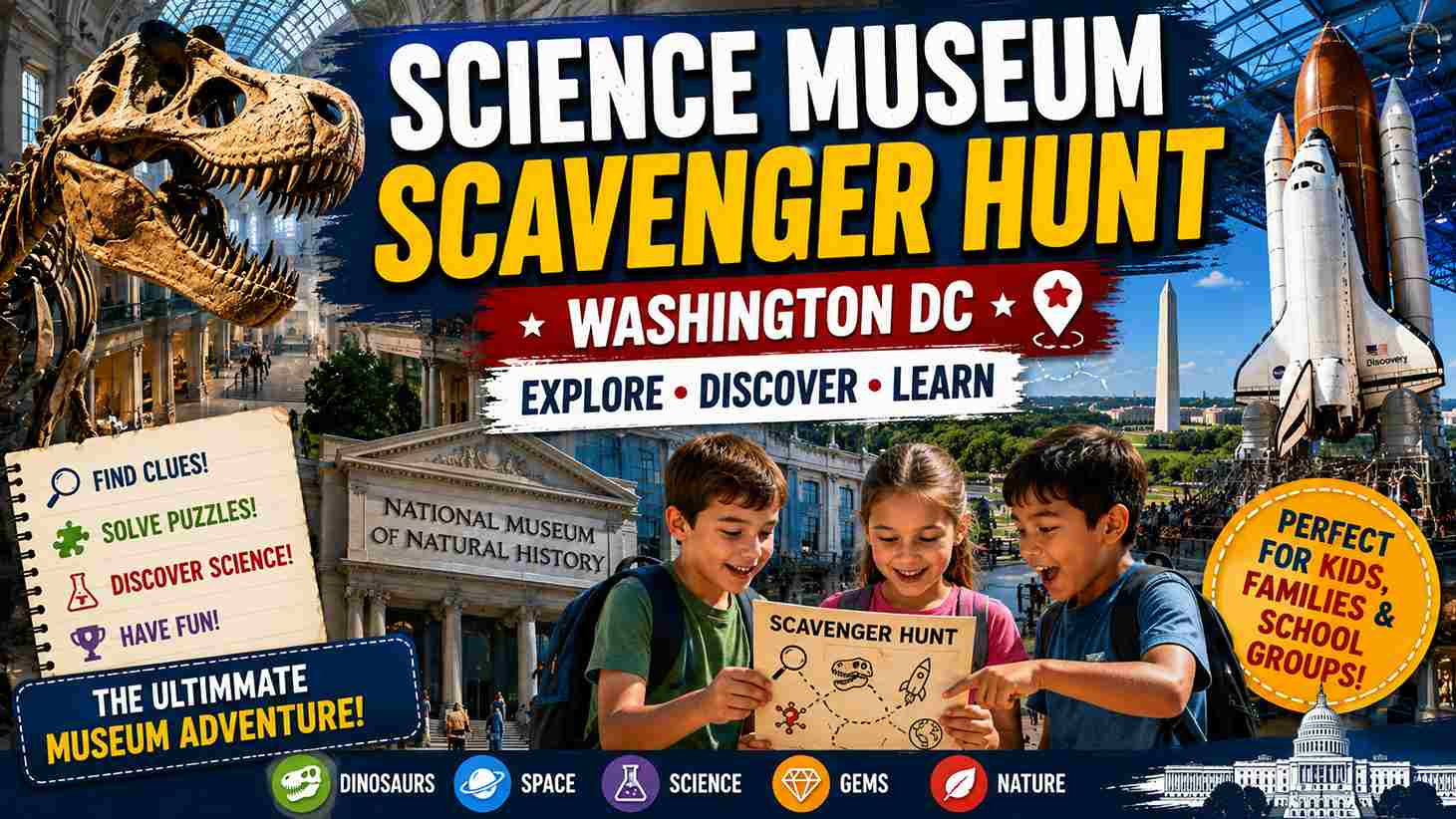
If you’re searching for the perfect combination of education, adventure, and family fun, a science museum scavenger hunt Washington DC experience should be at the top of your list. Washington, DC is home to some of the world’s most impressive science museums, interactive exhibits, and educational attractions. But instead of simply walking from exhibit to exhibit, imagine turning your visit into an exciting mission where every clue unlocks a new discovery.
A well-designed scavenger hunt transforms an ordinary museum visit into an unforgettable experience. Whether you’re visiting with children, students, friends, or coworkers, this guide will show you exactly how to plan, enjoy, and get the most out of a science museum scavenger hunt in Washington, DC.
What Is a Science Museum Scavenger Hunt?
A science museum scavenger hunt is an interactive activity where participants search for specific objects, exhibits, facts, or hidden clues throughout a museum.
Instead of passively reading display signs, visitors actively engage with exhibits by solving puzzles, answering science questions, finding unique artifacts, or completing small challenges.
The goal isn’t simply to finish first—it’s to encourage curiosity, teamwork, observation, and critical thinking.
Many teachers use scavenger hunts during field trips, while families enjoy them as a fun way to keep children engaged throughout the visit.
Why Washington DC Is Perfect for a Science Museum Scavenger Hunt
Washington, DC offers one of the richest collections of museums anywhere in the world. Many of them feature hands-on science exhibits covering everything from space exploration to dinosaurs, geology, biology, engineering, and environmental science.
Because several museums are located close together on the National Mall, visitors can even create a multi-museum scavenger hunt covering different scientific themes in a single day.
The city’s museums are designed for learners of all ages, making them ideal for:
- Families with kids
- School field trips
- Homeschool groups
- STEM clubs
- Birthday parties
- Corporate team-building events
- Tourists seeking an interactive experience
Best Museums for a Science Museum Scavenger Hunt in Washington DC
1. Smithsonian National Museum of Natural History
This is arguably the most popular location for a science-themed scavenger hunt.
Participants can search for:
- The Hope Diamond
- Dinosaur skeletons
- Ancient fossils
- Ocean exhibits
- Giant African elephant
- Human Origins gallery
- Butterfly Pavilion
- Mammal Hall
- Volcano displays
- Meteorites
Because the museum covers multiple branches of science, it’s ideal for beginner and advanced scavenger hunts alike.
2. National Air and Space Museum
Perfect for space and aviation lovers.
Scavenger hunt ideas include finding:
- The Wright Flyer
- Apollo Command Module
- Moon rock
- Space suits
- Mars rover models
- Rocket engines
- Planetary exhibits
- Satellite technology
- Space telescopes
- Historic aircraft
Kids especially enjoy missions that involve identifying planets or matching spacecraft with famous astronauts.
3. Smithsonian Castle and Gardens
Although not purely science-focused, it provides interesting clues involving:
- Architecture
- Botanical gardens
- Historic collections
- Museum history
It’s a great starting point before exploring nearby museums.
4. National Museum of American History
Engineering and innovation make this museum another excellent choice.
Possible scavenger hunt objectives include:
- Early inventions
- Transportation technology
- Robotics
- Computing history
- Scientific instruments
How to Create the Perfect Museum Scavenger Hunt
A successful scavenger hunt balances fun with learning.
Start by deciding the age group.
Young children enjoy picture-based hunts.
Teenagers appreciate puzzle-solving.
Adults often prefer trivia and observation challenges.
Next, choose between:
- Individual competition
- Team challenge
- Timed race
- Cooperative mission
Finally, prepare clues that encourage participants to read exhibit descriptions rather than simply locating objects.
Sample Science Museum Scavenger Hunt Questions
Here are a few examples.
Dinosaur Hall
Find the largest dinosaur skeleton.
How many horns does the Triceratops have?
Which dinosaur was a meat eater?
Ocean Exhibit
Locate the giant squid.
How deep can sperm whales dive?
Find an animal that produces light naturally.
Human Origins
How many bones are in the adult human body?
Which early human species walked upright?
Find the oldest human fossil on display.
Space Gallery
Which spacecraft landed humans on the Moon?
Find the smallest planet in our Solar System.
Locate a real piece of lunar rock.
Educational Benefits
A museum scavenger hunt is much more than entertainment.
Participants develop:
Observation Skills
Searching carefully encourages visitors to notice details they might otherwise miss.
Critical Thinking
Many clues require connecting information from different exhibits.
Reading Comprehension
Visitors naturally spend more time reading educational signs.
Teamwork
Group hunts build communication and cooperation.
Memory Retention
Interactive learning significantly improves information recall.
Tips for Families
Parents often worry children will lose interest after the first hour.
A scavenger hunt solves this problem.
To keep kids motivated:
- Divide the hunt into small missions.
- Offer small rewards after completing sections.
- Let children take turns reading clues.
- Include photo challenges.
- Mix easy and difficult questions.
The experience becomes less about walking and more about discovering.
Tips for Teachers
Teachers organizing Washington DC field trips can align scavenger hunts with classroom learning objectives.
Examples include:
Earth Science
Students identify different rock types, fossils, and minerals.
Biology
Locate mammals, insects, reptiles, and ecosystems.
Astronomy
Compare planets, rockets, satellites, and space missions.
Engineering
Study aircraft design, transportation, and inventions.
Providing worksheets encourages students to record observations instead of rushing through exhibits.
Digital Scavenger Hunts
Technology has made museum scavenger hunts even more engaging.
Many groups now use smartphones to:
- Scan QR codes
- Solve digital puzzles
- Upload team photos
- Record discoveries
- Answer quiz questions
- Track progress in real time
Digital hunts work particularly well for teenagers and corporate events.
Photography Challenges
Adding photography tasks creates another level of excitement.
Participants can photograph:
- The oldest fossil
- The brightest gemstone
- The biggest dinosaur
- The smallest exhibit
- Their favorite invention
- A space artifact
- An unusual mineral
- A colorful butterfly
Photography encourages visitors to observe exhibits from different angles.
Time Planning
A science museum scavenger hunt doesn’t need to last all day.
Suggested durations:
30 minutes
Ideal for younger children.
60 minutes
Perfect for most families.
90 minutes
Best for school groups.
2–3 hours
Excellent for museum enthusiasts who want an in-depth experience.
Trying to cover every exhibit usually leads to fatigue, so focus on selected galleries.
Common Mistakes to Avoid
Many first-time organizers make the hunt too complicated.
Avoid:
- Extremely difficult clues
- Rushing through exhibits
- Ignoring museum etiquette
- Creating overly long checklists
- Focusing only on speed
Remember, learning should always remain the primary objective.
Accessibility Tips
Washington DC museums are known for being accessible.
When planning your scavenger hunt:
- Choose wheelchair-friendly routes.
- Allow flexible timing.
- Include visual and audio clues.
- Provide large-print worksheets if needed.
- Ensure every participant can contribute regardless of age or ability.
Inclusive hunts create a better experience for everyone.
Why Science Museum Scavenger Hunts Are Growing in Popularity
Modern museum visitors want more than passive observation.
Families seek meaningful experiences.
Teachers look for active learning.
Companies want engaging team-building activities.
Scavenger hunts combine all of these into one memorable experience.
They transform museums into places where curiosity leads every step, making science feel exciting instead of overwhelming.
Final Thoughts
A science museum scavenger hunt Washington DC experience is one of the best ways to explore the nation’s capital while making science interactive, educational, and genuinely fun. Whether you’re discovering dinosaur fossils, touching a Moon rock, identifying rare minerals, or solving space-themed puzzles, every clue encourages deeper engagement with the exhibits around you.
The beauty of a scavenger hunt lies in its flexibility. It can be adapted for preschoolers taking their first museum trip, students studying STEM subjects, families looking for a weekend adventure, or adults seeking a creative team-building activity. Rather than simply walking through galleries, participants become explorers, investigators, and problem-solvers.
If you’re planning a visit to Washington, DC, consider adding a science museum scavenger hunt to your itinerary. You’ll leave with more than just photos—you’ll take home memorable experiences, fascinating scientific knowledge, and a renewed curiosity about the world around you.
FAQ
What is a science museum scavenger hunt?
A science museum scavenger hunt is an interactive activity where visitors solve clues, answer science questions and explore museum exhibits while learning through observation and teamwork.
Which museum is best for a science scavenger hunt in Washington DC?
The Smithsonian National Museum of Natural History and the National Air and Space Museum are considered the best choices because they offer hundreds of interactive science exhibits suitable for all ages.
Is a museum scavenger hunt good for children?
Yes. It improves observation skills, problem-solving, teamwork, reading comprehension and curiosity while making museum visits much more engaging.
Can adults enjoy a museum scavenger hunt?
Absolutely. Many companies use museum scavenger hunts for team-building events, while couples and tourists enjoy exploring museums in a more interactive way.
Are Washington DC museums free?
Many Smithsonian museums in Washington DC offer free admission, making them ideal for affordable educational trips.