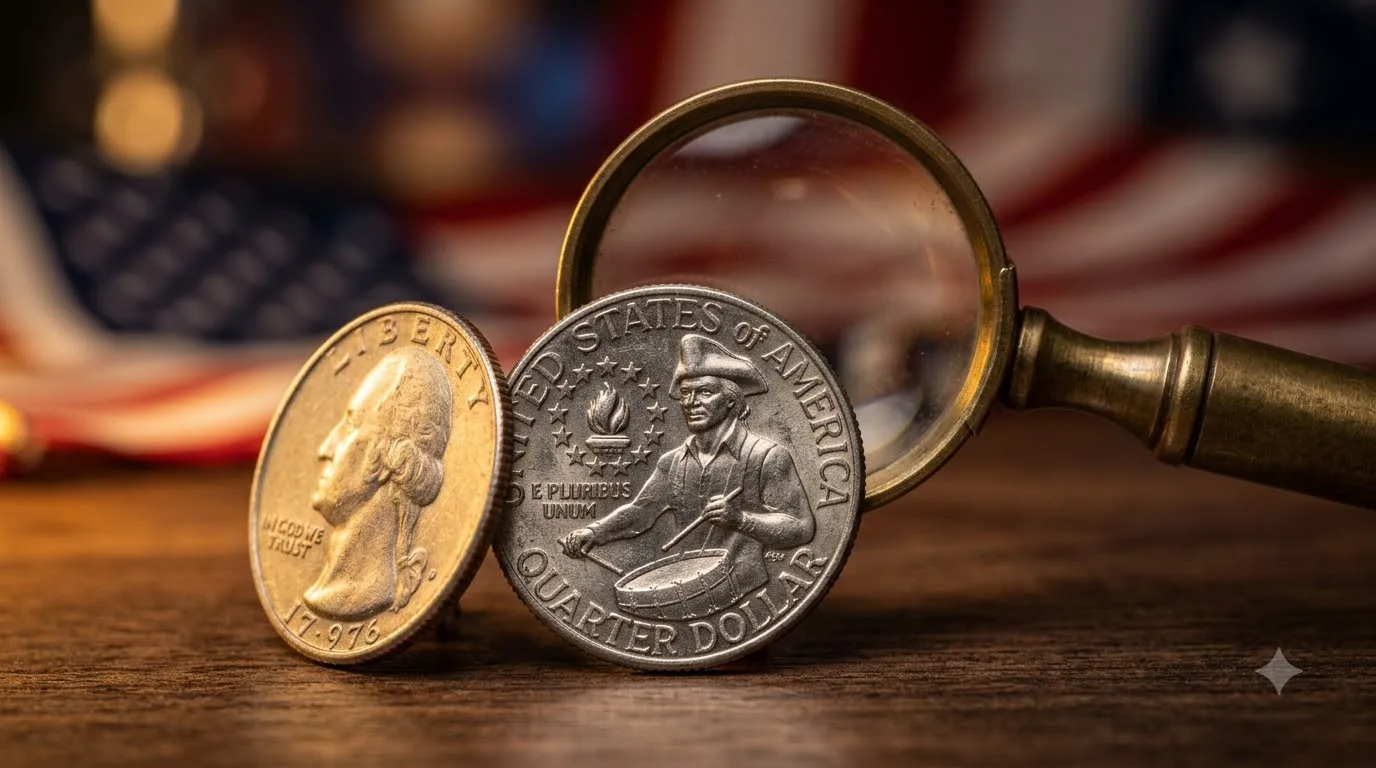
Quick answer: Most 1776-1976 Bicentennial quarters are worth face value, which is 25 cents. The ones that sell for more are the 40% silver versions (usually marked with an “S”), coins in top uncirculated or proof condition, and genuine error coins such as doubled dies or off-center strikes. Typical prices run from a few dollars up to several hundred for strong errors, and more for exceptional pieces.
Why Everyone Still Talks About This Coin
If you grew up in America, you’ve almost certainly handled one. The Bicentennial quarter was made to mark 200 years since the Declaration of Independence, and it turned up in pockets, jars and cash drawers for decades.
The design is easy to spot. The front still shows George Washington, but the back swaps the usual eagle for a colonial drummer with a victory torch encircled by thirteen stars. Both sides carry the dual date 1776-1976.
Here’s the catch that surprises people. Every one of these quarters carries that dual date, even though they were struck in 1975 and 1976. You won’t find a regular quarter dated 1975 or 1976 from that period, so the date alone tells you nothing about rarity.
Why Most Bicentennial Quarters Aren’t Worth Much
Mintage is the first thing collectors check, and this coin was made in huge numbers. The Philadelphia and Denver mints each produced hundreds of millions of them. Because so many people saved them as souvenirs, plenty of uncirculated examples still exist.
That’s why a worn coin from your change jar is usually worth 25 cents. Rarity drives value, and common coins in common condition simply don’t have it.
How to Check Where Your Coin Was Made
Look for a small mint mark on the front, just to the right of Washington’s ponytail.
- No mint mark: Philadelphia. Struck in clad (copper-nickel).
- D: Denver. Struck in clad.
- S: San Francisco. These came as collector sets, and some are 40% silver.
The mint mark is your first clue. Philadelphia and Denver coins were made for circulation, while the San Francisco coins were made mainly for collectors.
How to Tell If Yours Is Silver
This is the quickest way to find a coin worth more than face value. A few simple checks:
- Look at the edge. A regular clad quarter shows a copper-coloured stripe. A 40% silver one has a solid silver-looking edge with no stripe.
- Check the weight. Silver versions weigh about 5.75 grams, while clad ones weigh about 5.67 grams. You’ll need a scale accurate to 0.01 grams.
- Check the mint mark. Silver Bicentennial quarters carry the S mint mark, but not every S coin is silver, so use the edge or weight as well.
Silver coins are usually worth a few dollars or more depending on the silver market. Proof versions, which have a mirror-like finish and frosted design, tend to sell for more.
Bicentennial Quarter Value Chart (Typical Ranges)
| Type | Typical value |
|---|---|
| Circulated clad (P or D) | 25 cents |
| Uncirculated clad | About $1 to $5 |
| Top-grade graded uncirculated | Can reach hundreds of dollars |
| 40% silver, uncirculated | A few dollars, tracks silver price |
| 40% silver proof | Roughly $5 to $15 |
| Deep cameo proof, top grade | Higher, depending on grade |
| Error coins | From tens of dollars to several hundred or more |
These are estimates. Prices change with the silver market, the grading company, and where you sell.
Rare Errors Worth Looking For
Errors are where a plain-looking quarter can turn into something special. Keep an eye out for these:
- Doubled die: Letters or numbers look split or doubled, especially in the date and inscriptions. A magnifier helps.
- Off-center strike: The design sits visibly off to one side, leaving part of the coin blank.
- Wrong planchet: A quarter struck on a blank meant for another coin, which changes its weight and size.
- Double strike: The coin was hit twice, leaving a second, overlapping image.
- Clipped planchet: A curved bite is missing from the edge.
- Die cracks and cuds: Raised lines or lumps caused by a damaged die. These usually add only modest value unless they’re dramatic.
Small flaws like scratches, dents or damage from circulation are not errors. They lower a coin’s value instead of raising it.
What Affects Price Most
Four things matter, in roughly this order:
- Condition: Coins with sharp detail and no wear sell for far more.
- Metal: The silver content gives a floor price that clad coins don’t have.
- Errors: A confirmed, well-documented error can multiply the value.
- Grading: A coin graded by a trusted service like PCGS or NGC is easier to sell and usually gets a better price.
What Not to Do
Don’t clean your coin. It’s tempting, but polishing leaves tiny scratches and strips the natural surface that collectors look for. A cleaned coin can lose most of its premium. Hold it by the edges and store it in a soft holder.
Where to Sell a Bicentennial Quarter
For common coins, a local dealer or coin shop is the simplest option. For silver and error coins, you’ve got a few routes:
- Coin dealers: Fast and safe, though offers can be lower than retail.
- Online marketplaces: Larger audience and higher potential prices, but you’ll pay fees and need good photos.
- Auction houses: Best for high-grade or rare error coins.
Get a second opinion before you sell anything valuable-looking.
Frequently Asked Questions
Is a 1776-1976 quarter worth anything?
Usually it’s worth 25 cents. Silver, uncirculated or error versions can be worth more.
How much is a silver Bicentennial quarter worth?
Typically a few dollars, though the price follows the silver market, and proofs can sell for more.
Which Bicentennial quarter has the S mint mark?
Those struck at San Francisco. Some are 40% silver and some are clad, so check the edge.
Is there a rare Bicentennial quarter error?
Yes. Doubled dies, off-center strikes and wrong-planchet coins are the main ones to look for.
Should I get my coin graded?
Only if it looks uncirculated, proof-quality or has a clear error, since grading costs money.
Final Thoughts
The Bicentennial quarter is a great coin to learn on. Most are common, but a quick check of the edge, mint mark and surface can show you whether you’re holding a keepsake or something worth selling. Check before you spend.
Values are estimates and not financial advice.